IT
IT
22nd Apprenticeship Monitoring Report Presented
EMPLOYMENT, INAPP: “APPRENTICESHIP EMPLOYMENT ON THE RISE: 570,000 CONTRACTS IN ONE YEAR (+4.5% COMPARED TO 2021)”
Sharp increase in first-level apprenticeship enrolments, supported by PNRR funds
Forlani (President of Inapp): “The growth in apprenticeship employment and the development of dual apprenticeships (first level) are positive indicators. However, it is necessary to reform the apprenticeship system to address the causes of its underutilisation, by introducing greater flexibility in timelines to better align with the characteristics of labour market transitions. It is a question of valuing workplaces as training environments and recognising technical and professional pathways as opportunities for personal growth, cultural education, and self-esteem. A long-term strategy must be defined to sustain and strengthen the apprenticeship model with high educational value, even after PNRR resources are exhausted”,
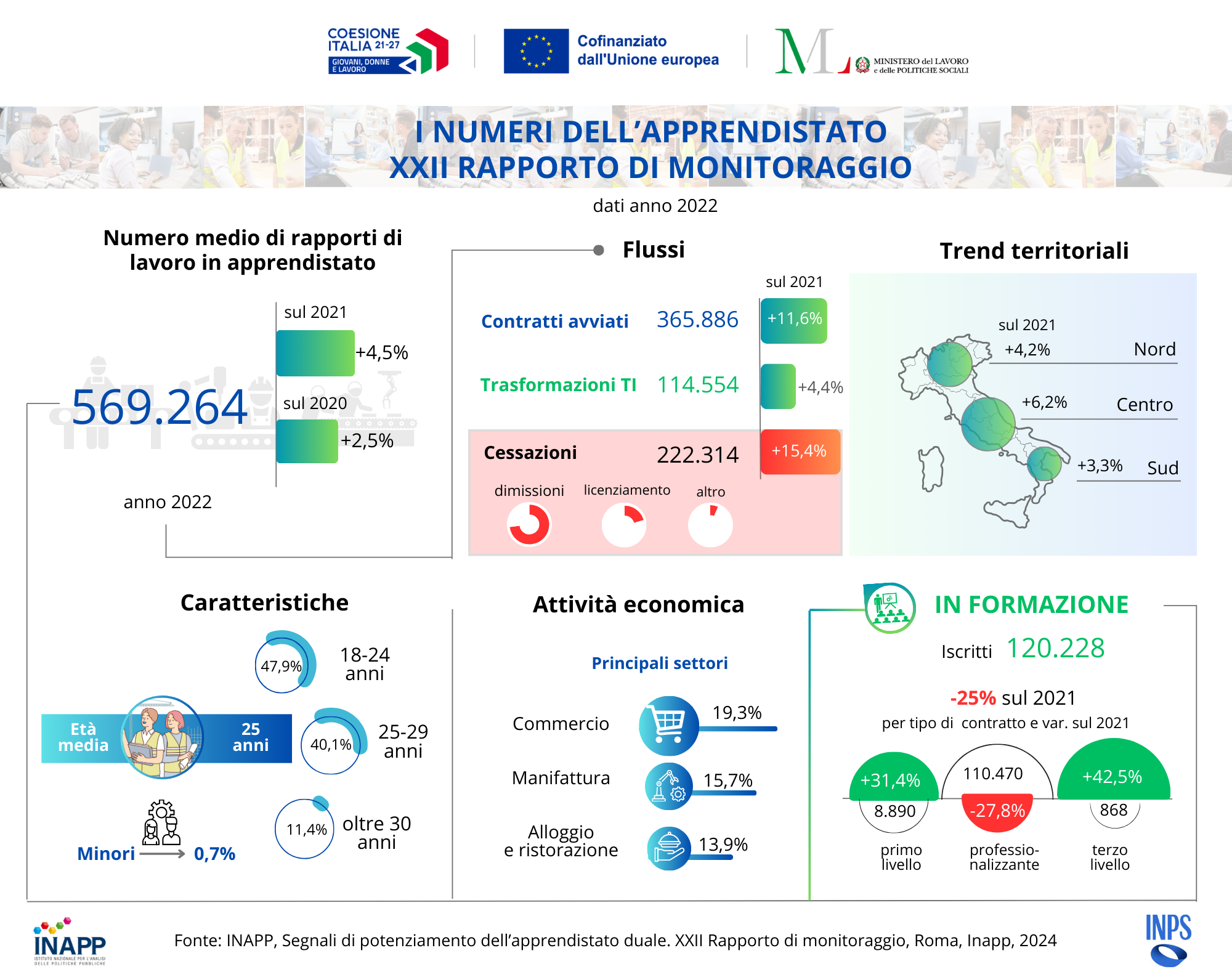
Rome, 21 November 2024 – Apprenticeship employment continues to grow. In 2022, the average number of apprenticeship contracts reached 569,264, showing a positive variation of 4.5% compared to 2021. Growth was recorded in all geographical areas, with the highest increase in Central Italy (+6.2%), followed by the North (+4.2%) and the South (+3.3%).
This is according to the 22nd Apprenticeship Monitoring Report, prepared by the National Institute for Public Policy Analysis (Inapp) on behalf of the Ministry of Labour and Social Policies. The report was presented today in Rome, in the presence of the Hon. Walter Rizzetto, President of the XI Committee on Public and Private Employment in the Chamber of Deputies, and Vincenzo Caridi, Head of the Department for Labour, Social Security, Occupational Health and Safety Policies at the Ministry of Labour and Social Policies.
The data highlight a strengthening of overall apprenticeship employment, coinciding with the economic and employment recovery following the severe pandemic crisis. The increase recorded in 2022 compared to 2021 extends to all forms of apprenticeship, with particularly significant growth in first-level apprenticeships (+14.8%) and third-level apprenticeships (+11%), while the increase in professional apprenticeships was more moderate (+4.3%).
Positive trends were also confirmed in terms of hiring and contract transformations. In 2022, 365,886 apprenticeship contracts were initiated (+11.6% compared to 2021), while 114,554 contracts were transformed from apprenticeship to permanent employment (+4.4% compared to 2021).
However, the number of apprenticeship contract terminations also rose, reaching 222,314 (+15.4% compared to 2021). As in previous years, the majority of terminations (73.1%) were due to resignations, while 20.5% were due to dismissals, and 6.5% to other reasons.
With regard to public apprenticeship training programmes organised by regions and autonomous provinces, 120,228 apprentices were enrolled in 2022, a decrease of approximately 25% compared to 2021. This reduction exclusively concerns professional apprenticeship enrolments (-27.8%).
Conversely, enrolments in first- and third-level training programmes increased. In 2023, 9,586 first-level apprentices participated in training activities (+7.8% compared to the previous year), while 1,417 third-level apprentices were enrolled (+63.2% compared to 2022).
“Nevertheless, there are critical issues that need to be addressed,” said Natale Forlani, President of Inapp. “Chief among these is the problem of territorial disparities: nearly 90% of first-level apprentices are in Northern Italy, and more than half of professional apprenticeship enrolments are concentrated in just three regions: Emilia-Romagna, Lombardy, and Piedmont.”
As Italy grapples with these challenges, the report notes that in EU countries investing in the dual system, the apprenticeship model is being repositioned with innovative and hybrid approaches, increasingly integrated with non-academic higher education and tertiary education. This enhances its appeal to young people and businesses and contributes to innovation in the production system.
Another trend, driven by demographic changes, is the use of the dual system in several EU countries to support upskilling and reskilling of adult workers (aged 25 and over). Factors promoting adult apprenticeships include the flexibility of training provision (e.g., personalised learning paths and recognition of prior learning), fair remuneration schemes for adults, and the credibility of qualifications issued through vocational education and training systems, which hold high value in the labour market.
The report can be downloaded at this link.
For further information:
Presidency – tel.0685447700
Email: [email protected]